
5 Popular Japanese Fairy Tales and Children's Stories
Many Taishu Engeki stories are inspired by Japanese legends, fairytales and folklore. Many stories have themes of magic, choosing between duty and emotions, family, and good prevailing over evil. If you are an English speaker, you may have heard of fairy tales such as “Jack and the Giant Bean Stalk”, “Robin Hood”, or “Peter Pan”. Japan has similarly magical folktales and stories of their own, which are passed down from generation to generation, and some are inspired by historical events or figures, blending between fantasy and reality over time.
1. Kaguya Hime / Princess Kaguya
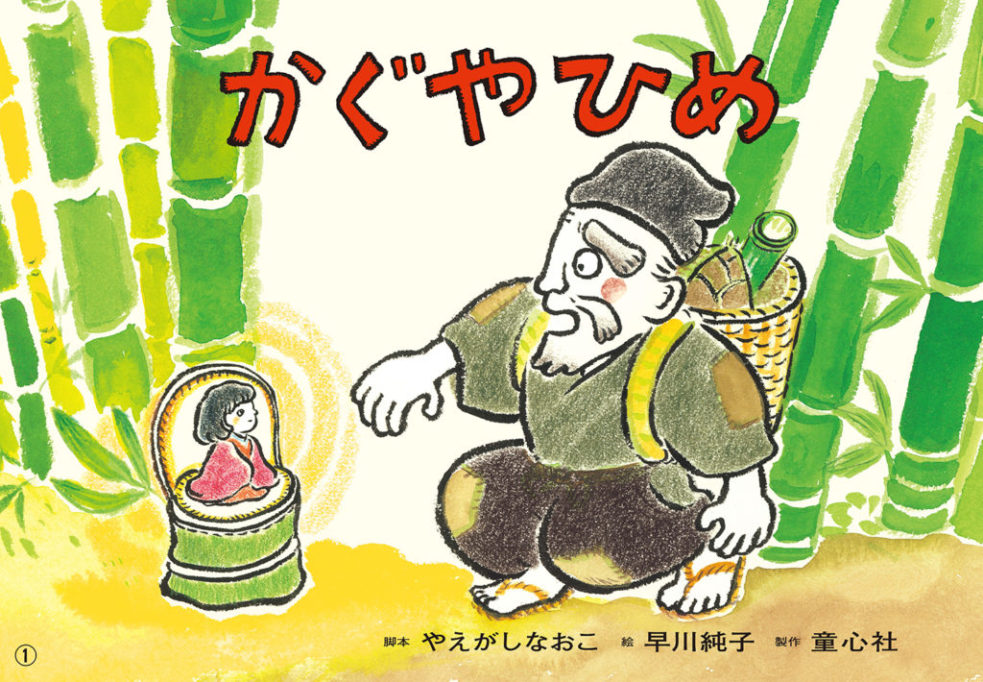
The Japanese Folktale which inspired the 2013 Studio Ghibli film “The Tale of the Princess Kaguya”, this story is over 1000 years old, and has many different representations and adaptations in media since its creation. Also known as “The Tale of the Bamboo Cutter”, this story’s author and exact date of writing is unknown yet is widely thought to be the oldest piece of monogatari literature, and is extremely influential even in 21st century Japan. It has inspired (1) the widely popular Ghibli film (grossing over USD$27 million outside of Japan, and over ¥2 billion, or USD$22 million inside Japan), (2) a popular Japanese pop-rock band from the 1970s named Kaguyahime, (3) several non-Ghibli films such as Princess Kaguya (1935), Princess From The Moon (1987 live-action film), and countless anime.
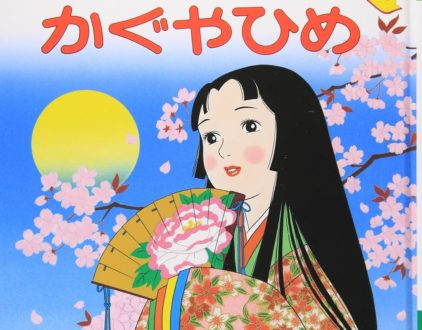
Cartoon Depiction of Princess Kaguya in Japan
The story revolves around an old man working in a bamboo forest who finds a strange, shiny bamboo stalk. Upon cutting open the bamboo stalk, the man finds a tiny infant who is the size of his thumb who is seemingly growing inside the bamboo. The old man, together with his wife decide to raise this child together and name her Nayotake Kaguya Hime. After the old couple took in Nayotake, the family becomes very lucky and wealthy, finding gold nuggets in each bamboo stalk the man cuts. In just three months, the young Nayotake becomes a fully grown, extraordinarily beautiful woman. At first, the old couple try to keep Nayotake a secret from outsiders, but her beauty attracts many noble suitors. Due to the high number of royal suitors, Kaguya Hime is uninterested, thus gives these men near-impossible tasks to grant her hand in marriage. Despite expressing distaste in marriage, Kaguya Hime attracts the attention of the Emperor of Japan, who falls in love and asks for her hand in marriage. She also refuses the Emperor, but remains in contact for a few years, communicating by handwritten letter.
Eventually, Kaguya Hime reveals to her adoptive parents that she is originally from the Moon, and must return to her people. She was sent to Earth as a punishment for unknown crimes, and the gold nuggets were a stipend to pay for her living costs. The day of her return to the Moon approaches, however the Emperor sends his guards to try and protect Kaguya Hime. Kaguya Hime’s people come to Earth to collect her, blinding the humans. Kaguya Hime writes sad notes of apology to her parents, and gives her parents her robe, and the Emperor an elixir of immortality alongside a personal note. As Kaguya Hime leaves Earth, she is also forced to forget all her memories of her family and the Emperor, leaving everyone in tears during the farewell. The Emperor reads Kaguya’s letter, and is met with extreme sadness. He asks his servants “Which mountain is the closest to Heaven?” The Emperor’s final act to try and communicate with Kaguya Hime is to climb the tallest mountain in Japan, burning the farewell letter in hopes that the smoke will be seen by Kaguya Hime. The woman known as Nayotake Kaguya Hime is never seen again by her parents or the Emperor.
2. Momotaro / Peach Boy
Momotaro is an extremely popular folktale in Japan, but does not quite have the fame of the previous Kaguya Hime. It tells the story of a boy born from a Peach who grows to be strong and eventually saves his village from demons. “Momo” is the Japanese word for Peach, and “Taro” is a common Japanese given name for males. There has been some adjustments to the beginning of the story from the story’s origination, thought to be from the 1400s. Some stories tell that Momotaro was found inside of a Peach, similar to the story of Kaguya Hime, whereas some tell that Momotaro was born naturally to an old couple who ate a peach to regain their youth.
A long time ago, there was an old couple living on a rural farm. One day, the old man went to the mountains to cut grass, and the old woman went to the river to wash clothes. While she was washing, she was surprised to see a what was a strangely large fruit floating down the stream of the river. She collected the fruit and discovered it was a peach the size of a watermelon, quickly finished her washing to return home, intending to give it to her husband after his hard work. She cut the peach in half, and out came a child.
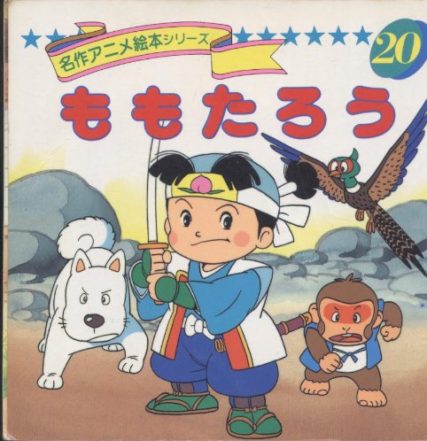
Children's Artbook Depiction of Momotaro
The old couple was childless, thus they rejoiced and named the child Momotaro, or ‘little peachling’. The old couple treated Momotaro as their own child, and he grew to become strong and intelligent. As Momotaro ages, he realizes he strangely stronger than everyone. He consults with his adopted parents about travelling to the nearby “island of devils”, to kill them and steal their riches, to bring back to his family. To support Momotaro, the old woman prepares him some dumplings to eat on his adventure.
As Momotaro heads towards the island, he first meets a dog. The dog says to Momotaro “if you give me a dumpling, I will go with you on your quest”. Second, Momotaro meets a monkey, and also asks for a dumpling. Third, he meets a pheasant, who he also gives a dumpling. All three animals join Momotaro on his quest to the island of devils. The four of them together break through the devil’s front gate, where they met and fought many strong demons with weapons. They fought through to encounter the chief of the demons, named “Akandoji”. Akandoji made the first strike on Momotaro, but Momotaro excelled even the strength of the Demon Chief, easily crushing and capturing him with a rope, and taking the prized possessions and riches of the demons. Momotaro returned home a hero, providing a feast for his family and his 3 new animal companions. Momotaro became a man of influence and riches, and a man to be remembered.
3. Kintaro / Golden Boy
Kintaro, known as “Golden Boy” in English, ironically is a similar tale to Momotaro. A child of superman strength, raised by a mountain witch (yama-uba). Kintaro is a popular character and story to portray in Bunraku and Kabuki dramas, and it is a superstitious custom to put up a doll of Kintaro on the Japanese Holiday “Boy’s Day, May 5”, in hope that young boys will become strong and brave like Kintaro.
He is also believed to be based on a real historical figure, Sakata Kintoki, from the Heian period (year 794 to 1185), who was well known as a strong warrior, working as a retainer for a samurai. Kintaro is a very well-known and popular character in Japan, being adapted into numerous different forms of media, inspiring characters in the One Piece and Gintama anime, the Persona 4, Nioh, and Mortal Kombat video games, among other lesser known franchises.
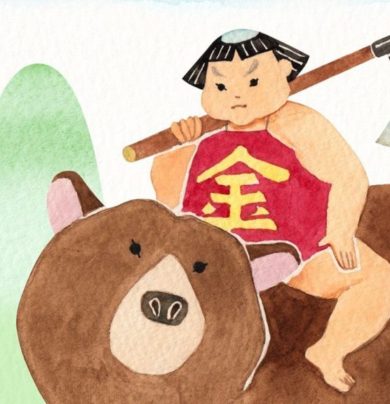
Depiction of Momotaro as a young boy riding a tamed bear.
Once Upon A Time, there was a strange yet strong young child living in the mountains, named Kintaro. He was pure of heart, yet possessed the strength of ten men, being able to smash rocks, lift trees, and break tree trunks with only his hands. He was the protector of his mother and the forest from danger of all kinds . Every day he would play with the animals of the mountains, including monkeys, rabbits, deer, and birds, even hosting sumo wrestling matches with the bears of the forest, and speaking the languages of the forest animals.
One day, a noble samurai named Minamoto Yorimitsu heard about the feats of strength of a strange young boy, and came to meet him. The samurai, impressed by Kintaro’s strength and ability, invited the child to become one of his warriors. Kintaro left the mountains, and began to help protect people all around Japan. Once Kintaro joined the Samurai, he was required to change his name – to Sakata Kintoki. Upon changing his name, this begins the blending of myth and historic accuracy, as there is a real historical figure named Sakata Kintoki.
4. Ikkyu-san / Mr Ikkyu
A story not related to a powerful or magical child, is the folktale of Ikkyu Sojun. A dedicated but intelligent and eccentric monk from the 1600s. In the late 1900s, the Ikkyu folktale gained widespread popularity in Japan due to the anime series Ikkyu-san, produced by Toei Animation (the same company which produces Dragon Ball), even becoming a known anime in China. However, the Ikkyu character within the anime series has little in common with the historical Ikkyu, which will be discussed.
Ikkyu’s mother was part of an important, wealthy family as the daughter of an aristocrat. However, rumors and drama forced his mother to leave the royal family and become a regular civilian with an ordinary village life in Kyoto, where Ikkyu was born. Ikkyu was sent to a temple in Kyoto to become a monk, at the very young age of 6 years old, where he was hailed as a prodigy, due to his intelligence and memory ability. In addition to his intelligence, he was famously witty and had a humorous way of dealing with various problems such as conflicts.
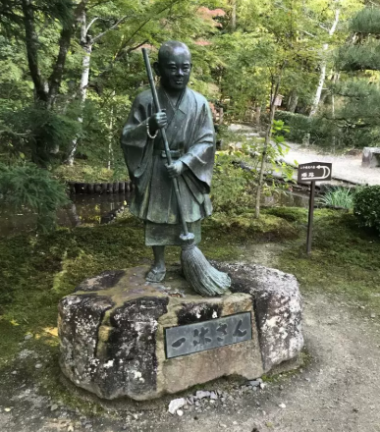
Statue honoring Ikkyu-san in the Kansai region of Japan
5. Hanasaka Jisan
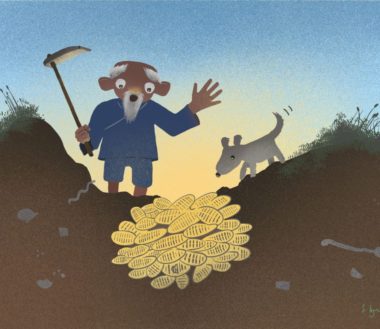
Hanasaka Jisan, or “The Old Man Who Made The Dead Trees Blossom”, is a Japanese folk tale from the 1800s., telling the relationship between a kind old man and his dog, and their relationship with a grumpy, greedy neighbor in the village.
The story revolves around an old couple living an honest life in a mountain village in Japan. The husband is outside, tending to his farm when one day a small, white puppy runs toward him, seemingly fleeing or afraid of something. The man adopts the puppy with his wife, beginning to care for it as their own. Shiro assisted the old man with his farm work every day, was fed well every day, and quickly grew into a large, strong dog.
Statue honoring Ikkyu-san in the Kansai region of Japan
One day, Shiro beckoned the man to follow him up a nearby mountain. Once they reached the top, Shiro signals the man to dig in a specific location. As the old man began digging, he quickly found some gold coins, which began streaming upwards into the air like a rush of water. Upon returning home, the old man’s infamously greedy neighbor became aware of Shiro’s intelligence and their newfound wealth. “I want to use Shiro too!” said the greedy old man, forcing Shiro to guide him to the same spot on the mountain. The old man demanded to be taken to gold, frightening Shiro into a whimper. The greedy old man mistook Shiro’s whimpers and concerned sounds for discovering the gold, and the man begun to dig. But, instead of gold coins, garbage began pouring upwards from the ground. Thinking it was a purposeful prank, the old man killed Shiro in retaliation.
When Shiro’s owners discovered Shiro had been murdered, they felt immense grief, but were helpless due to their old age. They dug a grave and buried the body of Shiro. A tree sapling grew from the grave of Shiro, and once a day had passed, it had grown into a very large tree. Shiro’s owners chopped down this tree for resources, and made a mortar (a mixing bowl). The old man’s wife wanted to prepare some rice cakes to take to Shiro’s grave as a gift, however, as the wife began using the mortar, the rice turned into gold coins.
Once again, upon hearing about this, the greedy old couple once again rushed over, demanding to use the same mortar. They also attempted to create rice cakes, selfishly seeking the gold coins. However, when they pounded the rice in the mortar, it turned into black sludge rather than gold. Once again, furious, the old man destroyed the mortar to pieces, and threw the remains into his cooking stove, turning them to ash. The honest old man was overcome with sadness again, gathering the ashes into a box, returning to his home again. The old couple sprinkled the ashes around the farm, which revived an old, dead tree which once again somehow suddenly bloomed beautiful cherry blossoms. News of the old man’s miracles reached the surrounding community, and eventually the Emperor. The old man brought these ashes to the Royal Palace to meet the Emperor, and once again sprinkled the ashes onto the surrounding trees at the Emperor’s request. “Amazing! Well done! You are the greatest flower bloomer in Japan!” granting the old couple with copious feasts and gold.
One final time, the greedy old man came once again, with remnants of the ashes he created from the destroyed mortar. “Wait, no! I am the true greatest flower bloomer in Japan! I will show you!” He exclaimed, and attempted to sprinkle the ashes himself. However, the wind blew these ashes into the face of the king, and causing him to choke. “You Idiot!” the king yelled, and immediately threw the greedy old man into prison.
Written and Published by Liam Hallin