Live Theatre and Performing Arts in Korea
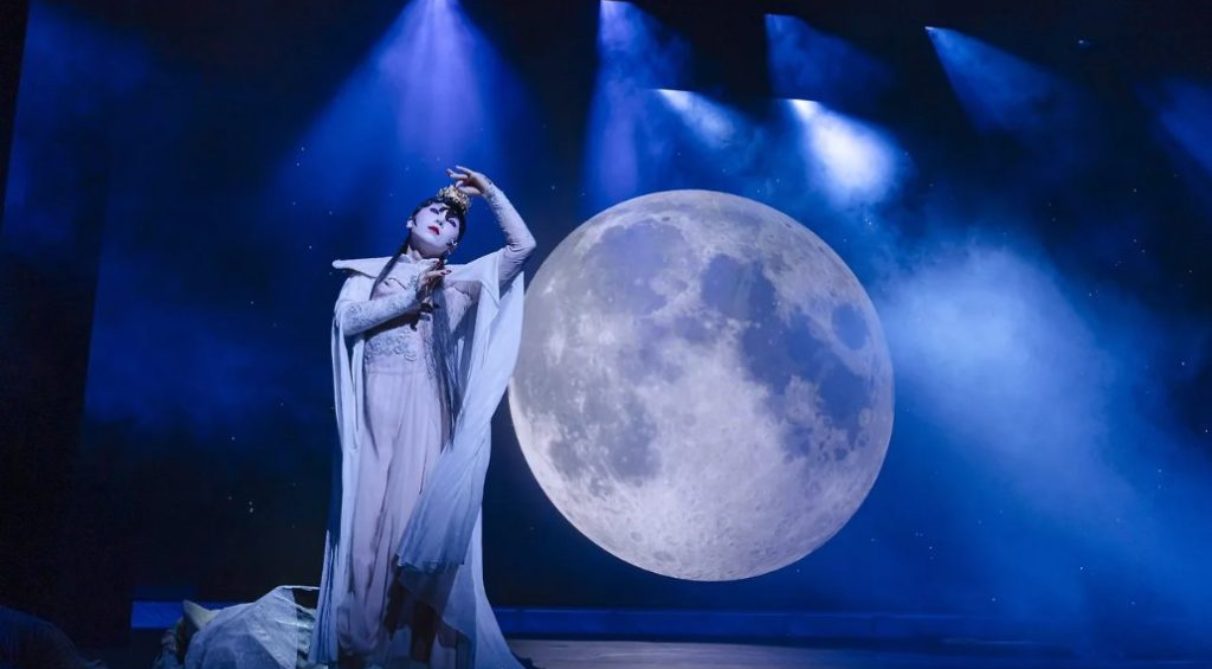
National Theatre Company of Seoul (C) / 2014
Japan and Korea are both very historical Asian countries which possess rich, ancient traditions. As Japan and Korea share many characteristics rooted in East Asian culture and storytelling, the performance styles have evolved independently over time. In Japan, Kabuki represents the country’s most celebrated classical form of performance art, while Taishu Engeki offers a more accessible, affordable form of theatre. You can read further about the accessibility of Taishu Engeki here.
In Korea, there are many different forms of theatre, but the two closest to Kabuki and Taishu Engeki are known as “Changguk”, and “Madanggeuk”. Changguk (창극) translates into English as “sung drama”, and adapts the country’s traditional music and storytelling into large musical theatre productions, comparable to Kabuki, or an operatic drama. Madanggeuk (마당극), translates into English as “outdoor/courtyard theatre”, and is a smaller scale, outdoor theatrical drama production
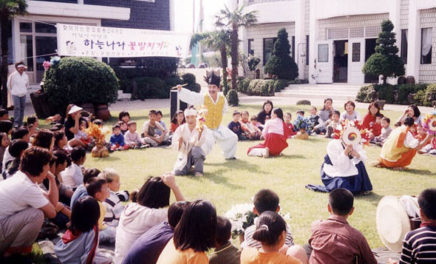
which heavily involves audience participation
Changguk
An Operatic Live Drama
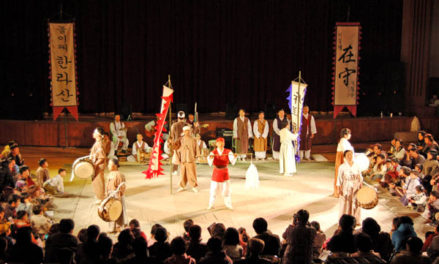
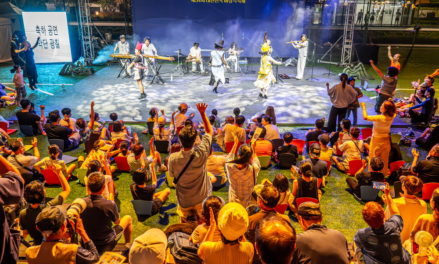
Changguk is Korea’s traditional, live, musical drama performance. It is a fully staged performance in large theatres, featuring multiple performers all in specific roles, singing, acting, and performing in orchestra. The performances combine traditional Korean instruments such as the Buk (drum) and Gayageum (a long, wooden string instrument), with European instruments such as the violin and piano. Historically, Changguk is dated as far back as 3000 years ago to 1000 BC, and was used as a traditional, spiritual performance to draw in spirits by Korean shamans.
In the 1900s, the popularity of the original, Shamanistic form of Changguk as entertainment theatre began to heavily decline due to Korea opening it’s borders to foreign countries and thus new forms of entertainment. Korea was heavily inspired by new waves of Japanese and modern Western drama, especially with the rise of Hollywood cinema. However, there was a resurgence of Changguk popularity in the 1960s due to the creation of ‘The National Changguk Company of Korea’, who began producing more modern performances with upgraded stages and fresh interpretations of traditional Korean stories. The Company also began adapting classic, popular creative works from overseas into the Changguk form, to great success. Korean directors successfully adapted the works of Shakespeare such as Hamlet, and popular Greek tragedies such as Medea. Similar to Kabuki, there are often themes of romance, suspense, and the triumph of good over evil, placing the protagonists in seemingly impossible circumstances and rewarding their perseverance with a happy ending for the viewers.
One of the current most popular Changguk stories is that of Chunhyangga (춘향가), the story of a young woman named Chunhyang from the working class of Korea who falls in love with a high-ranking government official named Mongryong during the time of the Joseon Dynasty (1300s – 1800s). The two get secretly married, Chunhyang is kidnapped by a corrupt government official after confessing his love for her and being rejected due to her marriage to Mongryong. Mongryong becomes a secret, royal inspector, investigating corrupt government officials, and eventually rescues Chunhyang from her torture. As expected – typical, great K-Drama stuff.
Madangguk
Outdoor Arts for the Youth
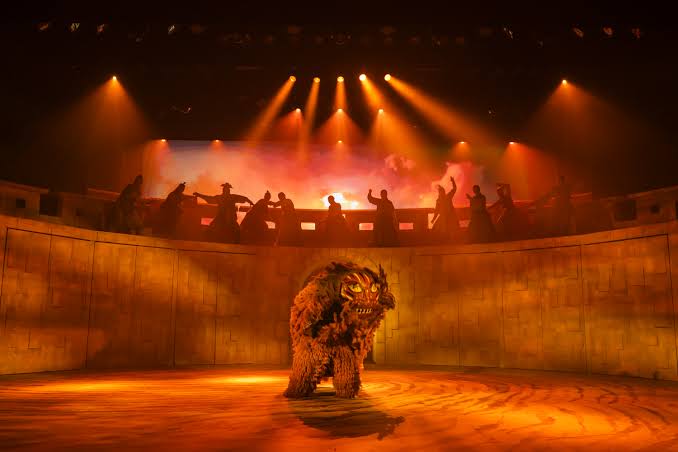
Madangguk is outdoor, courtyard theatre – a unique alternative for those in Korea wanting to experience live theatrical performances. Unlike Changguk, Madangguk is performed in large, open spaces such as courtyards, public squares or parks, or even at festivals and parades. There is no stage or elevated platform for the performers. The performance takes place on the ground surface, in very close vicinity to the audience where they can feel immersed and may even participate directly in the performance, as the actors sometimes ‘break the fourth wall’. This immersive, interactive atmosphere of Madangguk is the defining characteristic which separates it from other forms of theatre. Akin to Taishu Engeki, audiences are encouraged to laugh, sing, or clap during the performance, facilitating a communal experience.
Madangguk was popularized in the 1960s almost as a form of political protest during a period of repression. As Madangguk is performed outdoors, with much more minimalistic sets, costumes and facilities, it became very accessible and cheap to perform – and thus cheap to attend and enjoy. Performances often addressed political and social issues such as inequality, democracy, class and workers’ rights. It became a form of cultural expression and social commentary in universities, gaining popularity with the youth to communicate their dissatisfaction with the Korean national identity.
Many of the most well-known Madangguk productions mix the traditional East-Asian storytelling with contemporary social themes. The first major production is named “Jino-gut” (진오귀굿), an anthology drama which explores inequality and social injustice. The title is referring to the traditional Korean shaman ritual named “gut”, used to guide restless spirits into their afterlife. It is a series of episodes telling individual stories exposing the hardships of ordinary Koreans living under the Authoritarian rule of Park Chung-Hee in the 1970s.
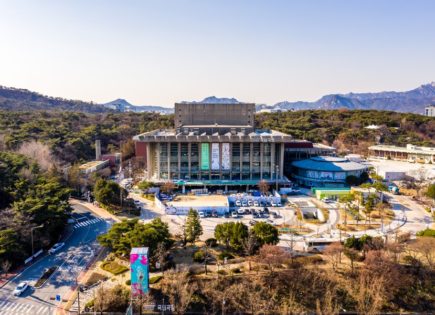
The National Theatre of Korea
This is the home base of the National Changgeuk Company of Korea, based in the capital city, this is the central institution and location for modern Changgeuk productions, works, and seasonal Korean festivals. It is not just a building, but a large entertainment village. The company was founded in 1962, and still has shows almost every day, and sometimes twice a day!
The National Theater of Korea (NTOK) hosts not only Changgeuk, but other forms of theatre and entertainment such as Gugak, Dance, Drama, International Festivals, and other large-scale events. One single theatre cannot handle the demand for live entertainment in Seoul, thus all the different theatres have unique stage shapes, acoustics, seating capabilities, etc.